
Workforce Intelligence
Understand the relationship between people, roles, teams and organizational structures before hidden misalignment becomes performance loss.
Skills and experience explain what someone can do. Persona adds visibility into how naturally the person, role and team can work together.

Talent & Hiring
- AI-assisted CV and role requirement analysis
- Behavioral assessment
- Candidate–role and team fit
Workforce Intelligence
- Role fit and team fit
- Team complementarity and stability
- Organizational alignment
Leadership & Development
- Leadership readiness
- Succession and role transition
- Personalized development insights
Retention & Risk
- Retention risk signals
- Role misfit signals
- Team strain visibility
Persona provides decision intelligence and behavioral visibility. Hiring and people decisions remain with your team.
What weakens organizations is rarely a lack of talent — it is misalignment noticed too late.
People decisions are often made on CVs, experience, managerial observation and short-term performance. Persona HR makes the human structure visible at person, role, team and organization level — and turns that visibility into management decisions.
Misalignment surfaces late
Someone can be doing the job without a healthy fit between person and role. Some placements look fine at first; the cost shows over time.
Hidden strain wears the structure down
Low sustainability, role strain and uneven workload may not cause a crisis on day one — but over time they tire both the person and the team.
Critical roles can become fragile
Critical roles without backup, knowledge held by a few people and leadership tied to specific names weaken what the organization can carry.
Risk seen late costs more
When misplacement, weak succession and retention risk are not seen early, the cost is not only people — it is time, productivity, continuity and decision quality.
People data, turned into management indicators
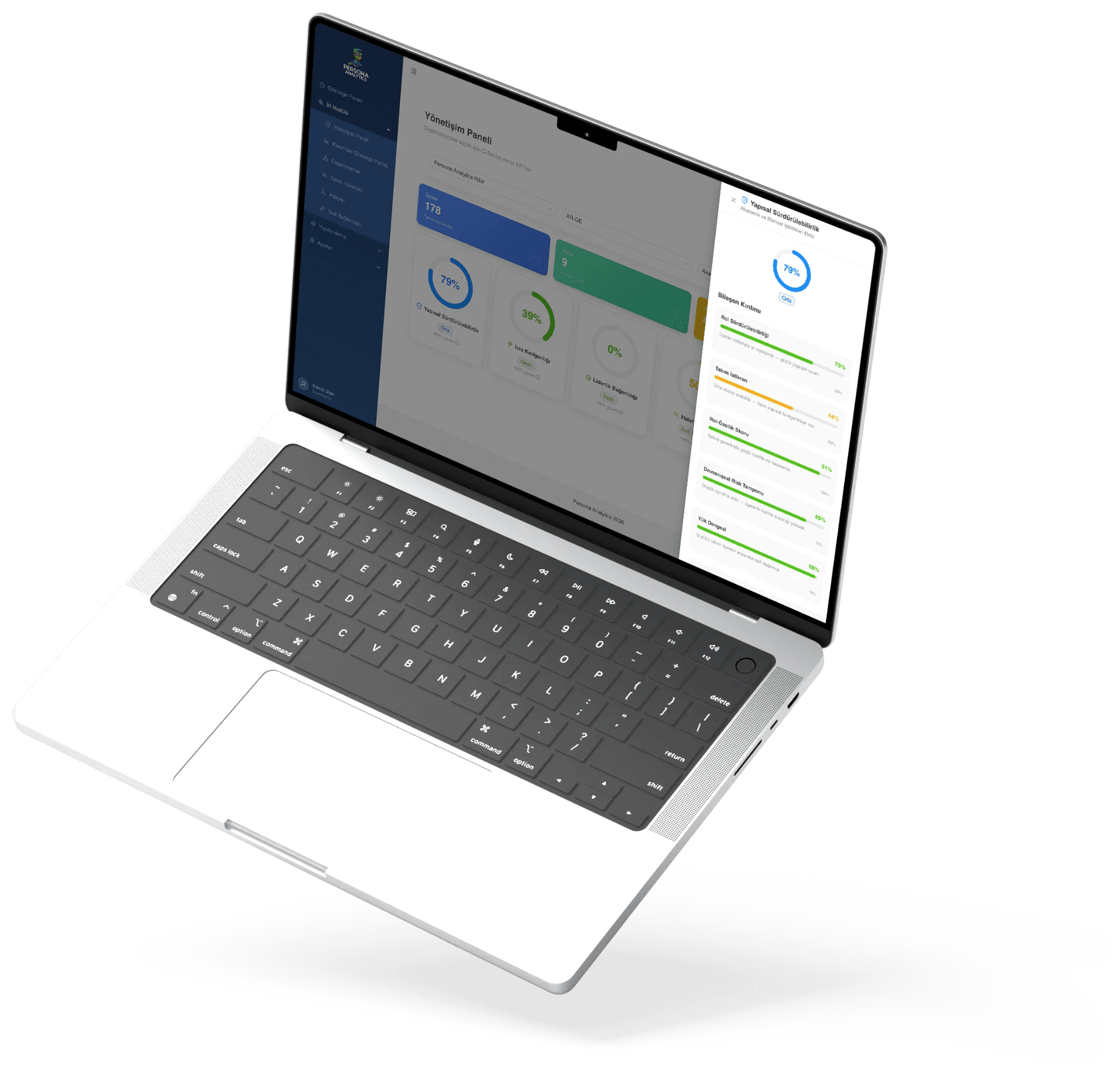
Persona HR turns team data into indicators management can read, prioritize and act on — showing not only how a team works today, but where fragility is building up.
Structural sustainability
How well the team can carry its current structure: role distribution, balance, workload sharing and behavioral resilience.
Execution fragility
How far the team's output depends on a few people, critical roles or narrow expertise.
Leadership dependency
How dependent the team is on a small number of leaders, and how prepared it is if one of them leaves.
Succession coverage
How well critical roles are backed up within the team.
Retention risk
Turnover risk seen together with the role's criticality and its effect on the team structure.
Ten modules, one view of the organization's human structure
Each module makes a different structural layer visible. Together they give management decisions a firmer basis.
Governance Dashboard
Structural sustainability, execution fragility, leadership dependency, succession coverage and retention risk at a glance, at management level.
Standards-based Role Definition
Turns role descriptions from free text into measurable profiles linked to global standards such as ESCO and O*NET, with the role's behavioral requirement profile alongside.
Department & Team Management
Assesses the fit, balance and resilience of each department and team, and makes the differences between them clearer.
CV Analysis
AI extracts skills, experience, education, language and seniority from CVs and compares them with the role's requirements for an explainable, consistent pre-assessment.
Role-based Complementarity
Shows not only whether a team is staffed, but how well it complements itself: coverage gaps, load concentrations and single-person dependencies.
Role Fit Analysis
Shows not just whether someone can carry a role, but how naturally, with how much strain and how sustainably.
Individual Employee Reports
Strengths, development areas, team fit, role fit and leadership suitability in one structured view.
Candidate & Assessment Flow
Applications, assessment invitations and results are managed in one place and linked to the candidate evaluation.
Retention Risk
Looks at turnover risk together with the role's criticality and structural impact, so attention goes to early signals instead of late losses.
Interview & Decision Management
Invitations, scheduling, evaluation and decisions in one structure; a hired candidate is linked to their department, team and role.
Compare a candidate's background with what the role actually requires
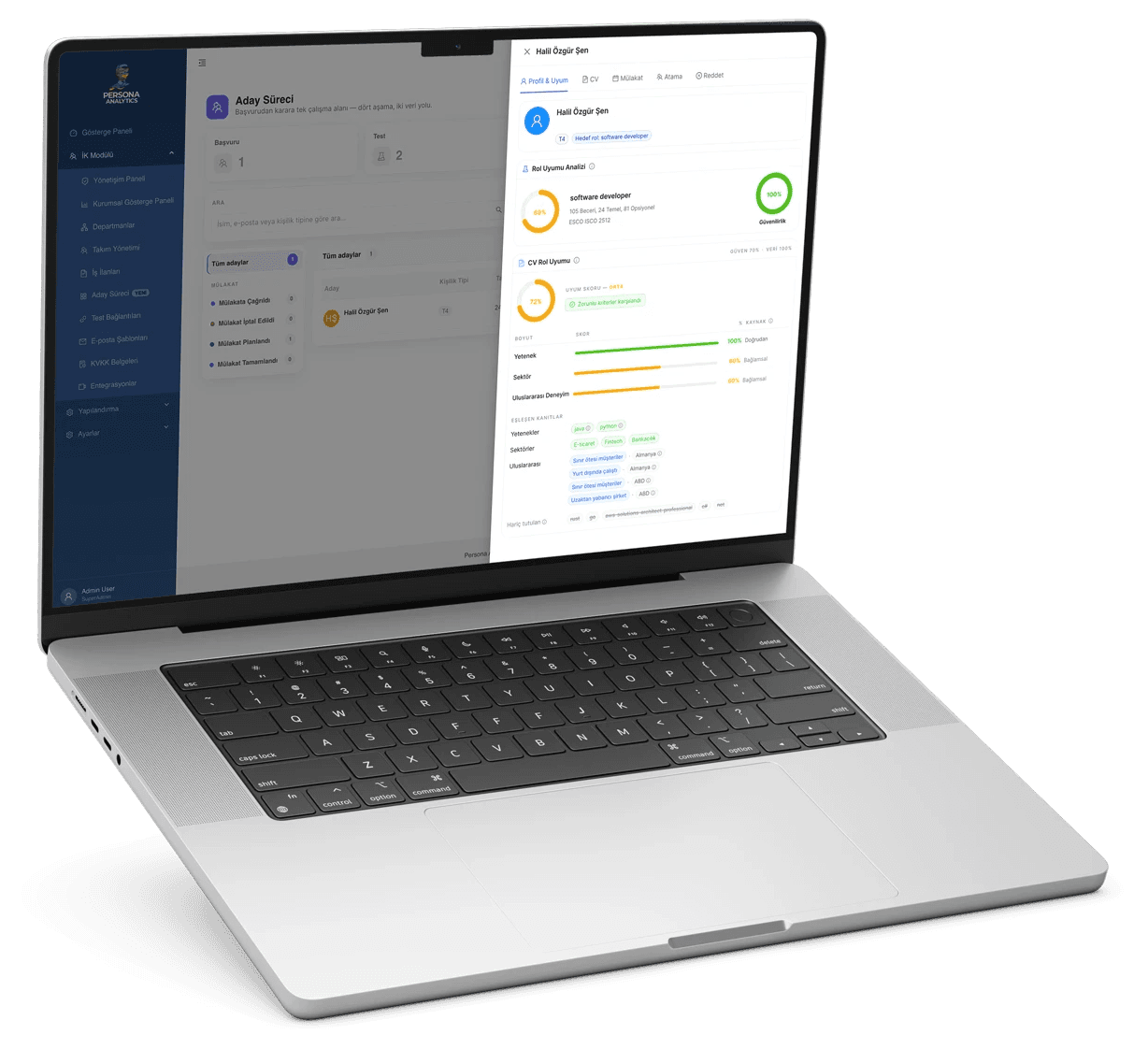
Roles are defined against global occupation and skill standards such as ESCO and O*NET. CV data is compared with the role's skill and experience requirements; inventory results with its behavioral profile.
Professional requirements
Skills and competencies, experience and seniority, education and certificates, languages, responsibilities.
Behavioral requirements
Working style, decision-making and problem solving, communication and collaboration, stress management and resilience, team contribution.
AI-assisted extraction
Skills, experience, education, language and seniority are extracted from the text.
Normalization
Different spellings of the same skill or title are reduced to one standard.
Comparison with the role profile
The candidate's profile is compared with the role's requirement profile, heading by heading.
Reading reliability
Every item extracted from the CV carries a reliability level.
Privacy masking
Personal data is masked before AI analysis, in line with KVKK.
From role definition to team impact, in one decision flow
CV, assessment, interview and decision move through the same candidate view with the same logic — an explainable, traceable chain rather than scattered steps. After hiring, the new member becomes part of the team analysis.
1 · Role definition
Tasks, skills and expectations are structured.
2 · Job posting
The posting is published within the same flow.
3 · Application
Candidate details and CV enter the system.
4 · CV analysis
Skills, experience, education and languages are extracted.
5 · Assessment
Suitable candidates are invited to the inventory.
6 · Interview
Invitations, confirmations and scheduling are managed.
7 · Decision
Hire, keep in the talent pool or decline.
8 · Team impact
The new member joins the team analysis.
Right placement, sustainable structure
A role being carried does not mean the structure is right, and a fully staffed team is not necessarily balanced, complementary or resilient. Persona HR looks at how natural and sustainable the person–role relationship is, and at the team's coverage, distribution and resilience.
Role fit
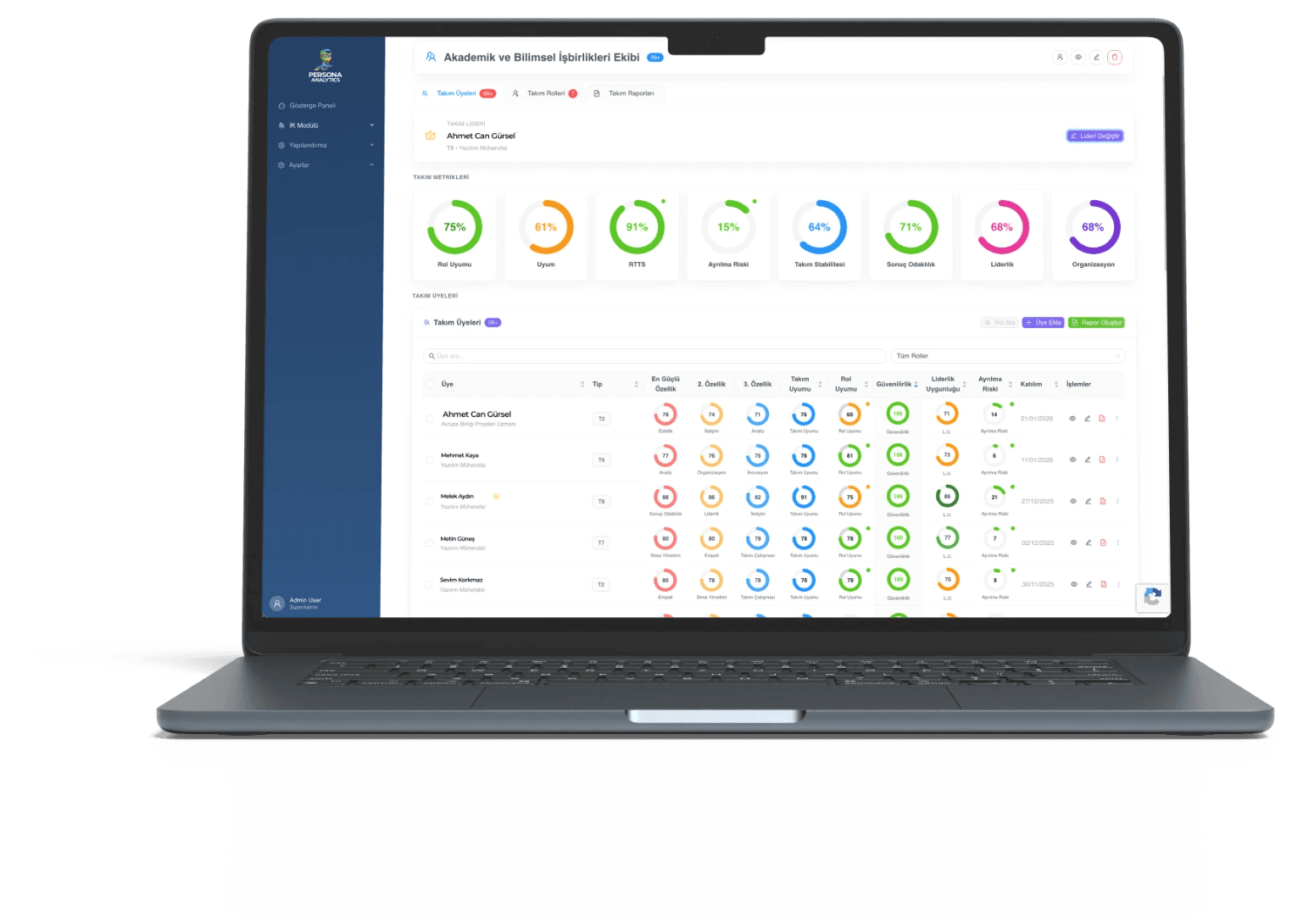
How naturally the person carries the role, how much strain it creates and how sustainably it can continue.
Role-based complementarity
How far the team meets its role requirements, where the coverage gaps are and how evenly expertise is spread.
Team stability
Shows when critical knowledge or responsibility is concentrated in a few people, so hidden fragility is noticed earlier.
From the individual view to structural continuity
Healthy decisions need both the team structure and a sound reading of the people in it. Persona HR connects the individual view to placement, leadership readiness, succession and continuity.
Individual employee reports
Strengths, development areas, team fit, role fit and leadership suitability in one structure — so decisions rest on more than impressions.
Development and placement
Used to build the right development plans and to strengthen placement decisions.
Leadership suitability and succession
Shows who could carry critical responsibilities in the future, helping plan succession and avoid concentrating leadership in too few people.
See your organization's human structure.
Tell us about your organization, and we will show you how Persona HR makes role fit, team balance and structural risk visible.